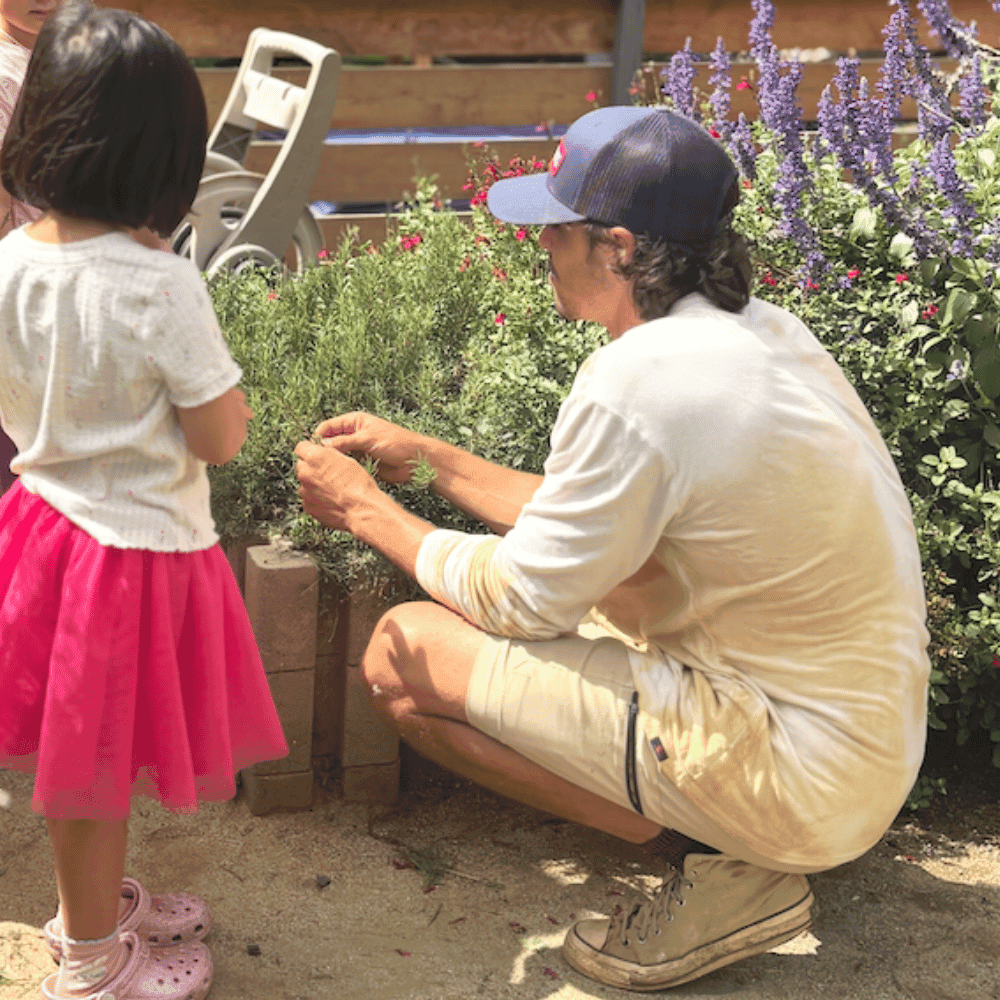
How teaching kids about water reminded me of the wonders of nature.
Last week I taught the preschoolers all about water.
It felt fitting given the recent heat wave and the fact that rain was expected in our weekend forecast.
In the lesson, we explored how water moves across landscapes and through different soil compositions.
The whole experience brought me back to when I was first introduced to these same ideas, only as an adult.
I recall learning what a watershed was, how the water cycle worked to recycle water through ecosystems, and strategies for moving and capturing water for productive uses, like irrigating a garden.
I left that day feeling so inspired!
I was like one of the preschoolers, wide-eyed and filled with wonder at the world around me.
I developed a newfound appreciation for rain. While everyone else would tuck themselves inside, I was eager to get outside and explore my neighborhood and its various gardens to see how water moved through them.
This habit also exposed places where water hadn’t been properly considered, often resulting in excessive runoff, erosion, and flooding.
In San Diego, we only receive about twelve inches of rain a year.
That’s not a lot of water for a region with millions of people, particularly when so much of our landscape is designed to shed it rather than absorb it.
With more of our land covered in concrete, pavement, and other surfaces that prevent water from soaking into the ground, much of the precious rainfall we receive simply runs off into storm drains and eventually the ocean.
In ecological landscape design, a core principle of sound water management is to “slow it, spread it, and sink it.”
Rather than seeing rainwater as a problem and attempting to move it off a property as quickly as possible, the idea is to treat water as a resource and design landscapes that allow it to remain where it can be put to good use.
At the farm, we’ve implemented several strategies to minimize water damage while capturing as much of this resource as possible.
The first strategy is building healthy soils.
Healthy soils, particularly those rich in organic matter and supported by good soil structure, can absorb and retain tremendous amounts of water. This helps reduce flooding and runoff while also limiting our reliance on city water to irrigate our crops.
Next, our raised beds act as a series of small berms that help slow and spread water during heavy rains.
Imagine a stream of water running downhill until it encounters a barrier. Rather than continuing straight down the slope, the water is encouraged to spread along the barrier, slowing its movement and giving the soil more time to absorb it.
That’s effectively what our raised beds do.
This is especially important because our farm sits on a downhill slope, where water naturally wants to gather momentum and carve channels through the landscape.
Lastly, we’ve sheet mulched much of the surrounding farm area to help improve water absorption while suppressing weeds.
Sheet mulching involves layering cardboard and generous amounts of mulch over the soil. Together, these materials help protect the soil from the impact of heavy rain, slow surface runoff, and encourage water to soak into the ground rather than rush across it.
Walking around the farm yesterday following Saturday night’s rain, I was happy with how everything looked.
No flooding. No obvious signs of erosion or runoff.
There was some wind damage to a few flower beds, and one of our light fixtures had blown down. But overall, things seemed to be in good shape.
I ended last week’s lesson by asking the kids to show me how they thought water would move across the preschool’s chicken coop.
With their tiny fingers, they traced lines down the slopes of each roof, some of which overlapped, creating interesting opportunities for water to change direction.
Then I poured water over the roof.
Watching the kids grin with satisfaction as their predictions came to life brought back the same feelings of joy I had experienced years earlier.
With the rainy season approaching, I encourage everyone to take a similar interest in water.
Observe how it moves across your own landscape.
Notice where it pools. Look for small channels that reveal where water is coming from and where it’s trying to go. Consider whether there are opportunities to slow it down, spread it out, and direct it toward places that would benefit from it, like a garden or a thirsty tree, rather than letting it rush into the street.
You might be surprised how much there is to discover just by paying attention.
From this perspective, watching water can be as entertaining as anything on Netflix.
Or so I like to think. :)
From our October 12 newsletter. If this is the kind of farm you want to support, our CSA is the most direct way to do it.