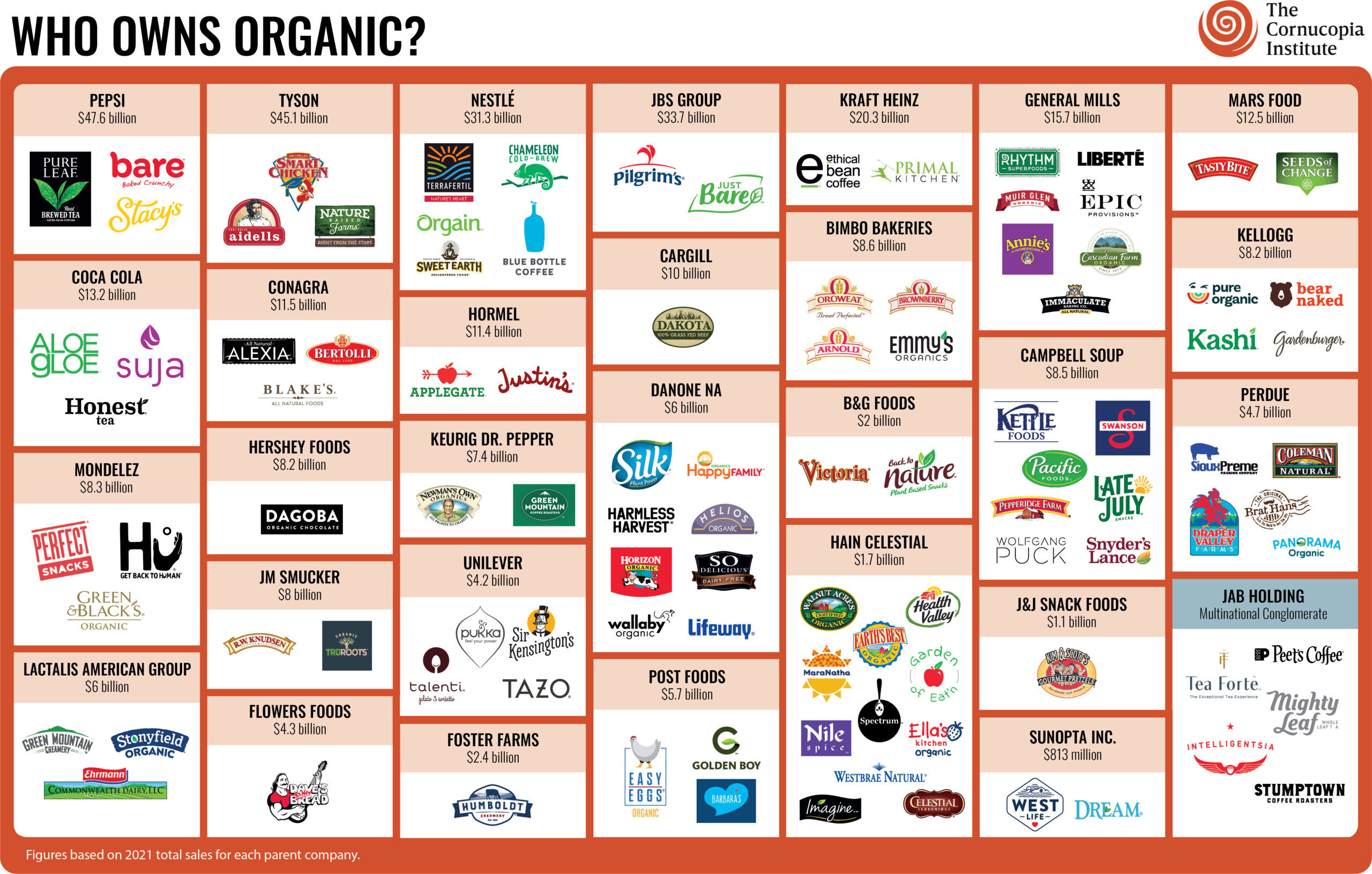
With the recent explosion of consumer interest in organic food, we’ve watched massive food manufactures build or acquire organic brands in an effort to hide behind smaller labels that appear independent.
Many of the organic products we see at the supermarket fall into this category: Cascadian Farm (General Mills), Pacific (Campbell’s), Horizon Milk (Danone). Others began as small, mission-driven brands before being bought by the giants—Kashi (Kellogg), Primal Kitchen (Kraft Heinz), Urban Remedy (General Mills).
In fact, there’s a [fascinating study](https://www.cornucopia.org/research/who-owns-organic/) that maps the entire web of major food manufacturers behind organic labels.
I don’t blame any company for wanting to participate in the organic movement—I believe in its long-term value as well. And I certainly don’t fault small organic food businesses for selling to larger corporations as it increases access to organic food and stimulates growth and investment in the industry.
I do worry, however, that the concentration of corporate power in the organic industry may gradually dilute the meaning of the organic label.
There is already some evidence of this.
The original 1990 Organic Foods Production Act (OFPA) required that any food labeled “organic” be grown in soil free from prohibited chemicals. Soil was the foundation of the standard. Today, many large-scale “organic” fruit and vegetable operations grow food hydroponically with plants raised in containers with little to no soil. These systems, often highly sophisticated and more reminiscent of assembly lines than farms, don’t use chemical sprays, but many soil-based organic farmers argue that they stray from the spirit of the original law.
That concern sparked the creation of the Real Organic Project, which offers an add-on certification meant to uphold the soil-based principles of the OFPA. Farmers already certified organic by the USDA can apply (for free) to receive this additional label, which distinguishes their products as grown in living, carefully maintained soils. More than one thousand farms now carry this certification (shout-out to Farm Lab who is a local participating farm).
But not all farms are able to become certified organic by the USDA. The process can be expensive—I’ve heard figures as high as $20,000—which puts it out of reach for many small growers. So while the organic label is a helpful guide when I’m shopping in places where I don’t know the farmers, I still prefer to buy from growers I’ve met or from people/grocers I trust deeply (shout-out to Jimbos Natural Market and Harvest Market at Fox Point Farms).
That’s exactly what we try to encourage at the tiny farm. Though we’re not technically certified organic, I invite anyone to come walk the rows, see the space for themselves, and ask anything about how we grow food.
At the end of the day, a certification is just one tool for building trust. But the strongest form of trust, in my opinion, comes from a direct relationship between the farmer and the community they feed.
✌️