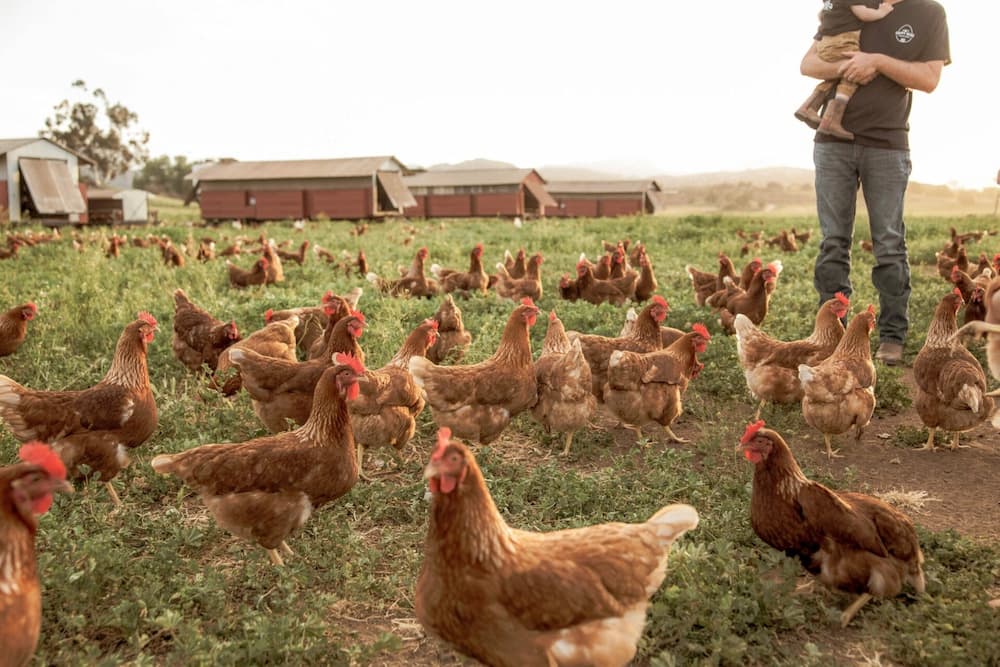
It was another dramatic week in food.
If you’ve been following the news, you may have heard about the local outbreak of Salmonella said to have originated from a small grocery store in Ramona.
In total, more than 20 cases have now been reported. Investigators have said the outbreak is linked to food prepared at the market using eggs supplied by a local egg producer, Happy Hens.
The news comes on the heels of two recent national produce outbreaks: July’s outbreak of Cyclospora linked to lettuce and August’s outbreak of Salmonella linked to jalapeños.
The fact that this local outbreak has remained relatively small compared with national outbreaks that can spread across dozens of states is, at the very least, a reminder of one of the advantages of smaller-scale, more local food systems.
But this local outbreak also brings to light many of the same traceback practices carried out by regulators that we’ve recently read about at a national scale.
And some of the questionable judgments that can be born from that process.
From the start, Happy Hens has denied claims that its eggs are what caused the outbreak.
According to the farm, they conduct frequent swab tests on their flocks to test for traces of Salmonella. In fact, they say a test performed in July came back negative.
Since the start of the investigation, Happy Hens has been compliant with regulators and transparent with its followers about the ongoing process.
I trust Happy Hens eggs.
They claim investigators were uninterested in conducting swab tests on their flocks, preferring instead to conduct an invoice audit to verify the sale of eggs to the Ramona grocer.
Regulators also rely on interviews with individuals who contracted Salmonella in order to identify shared foods they may have consumed. This is part of what investigators have said helped trace the outbreak back to eggs supplied by Happy Hens.
And yet, according to Happy Hens, regulators still haven’t conducted field testing at the farm.
Meanwhile, the association regulators have made between the outbreak and Happy Hens, which has since been amplified by local news outlets, has left this small-scale egg producer having to perform major damage control as vendors and customers naturally begin to question the safety of its products.
For a small business, that added effort to defend its product and reputation creates a serious additional workload.
Happy Hens has even agreed to conduct additional flock testing of its own in light of the allegations, highlighting the confidence they have in the quality and safety of their eggs.
Moreover, Happy Hens has pointed out that a large share of the eggs it distributes are sold outside San Diego County, including in stores throughout Orange County and the Central Coast, areas where the farm says no related cases have been reported.
That doesn’t 100% prove the eggs weren’t responsible. But, in my opinion, it’s pretty darn good evidence in favor of Happy Hens. Better evidence, I would argue, than what regulators have presented at this point in the investigation.
I personally stand with Happy Hens on this issue.
Of course, I understand that regulators are trying their best, with limited authority and resources, to isolate the source of this outbreak and keep the public safe from harmful foodborne illnesses.
That work is incredibly important.
But I think it is irresponsible to publicly associate an outbreak with a small family farm when the available evidence appears to suggest a linkage rather than definitively prove the source.
I trust Happy Hens eggs. I even bought some for myself on Thursday after looking more deeply into this story.
It will be interesting to see how this all plays out, and whether the same traceback practices used during large-scale national outbreaks can and should be applied in exactly the same way to outbreaks occurring on a local level.
When the suspected source is a nearby farm rather than a distant supplier buried somewhere in a national distribution network, it seems reasonable to ask whether we should be relying less on paperwork and inference alone.
Especially when we have the ability to actually go to the farm and test.
Oh and to our CSA add-on customers — don't be alarmed if your eggs this week are from Happy Hens :)